-
01-10-2026
Post-harvest care in fruit trees: How to rebuild reserves for the next growing season
Post-harvest care in fruit trees: How to rebuild reserves for the next growing season
When the fruit is harvested, the tree keeps working. What happens in the weeks following harvest determines next year’s sprouting, blooming and fruit setting.
Harvest is not the end of the cycle
Once the fruit have been harvested, the tree remains active and enters a critical phase: recovering the nutrients mobilized during production, maintaining its metabolic activity and accumulating reserves in the roots, trunk, branches and buds.
During crop development and ripening, the fruits act as major consumers and receive a considerable portion of the photoassimilates and nutrients absorbed by the plant. As a result, internal reserves may be depleted after harvest, especially when the crop load has been high or the crop has experienced thermal or water stress.
For this reason, post-harvest nutrition must be considered an essential part of the annual fertilization program, and not an optional add-on. The goal is for the plant to complete the cycle with an adequate level of reserves to face dormancy and the start of the next growing season.
Timing is crucial: The application window
In deciduous fruit trees, “when” matters just as much as “what”.
Post-harvest nutrition must be carried out after harvesting, but well before yellowing and leaf drop.
As long as the leaf area remains green and functional, the plant retains its photosynthetic capacity and can absorb foliar-applied nutrients, incorporate them into its metabolism and transport them to the permanent organs. As senescence progresses, metabolic activity and absorption capacity decrease, causing late applications to lose efficacy.
How long does this window last?
It depends on the species, variety, harvest date, water status, yield load and weather conditions:
- Early varieties: Longer period between harvest and leaf fall.
- Late varieties: A narrower window for intervention.
Therefore, the strategy must be adapted to the type of crop, the variety and the actual condition of the plant.
Why reserves determine the following year’s flowering
In many deciduous fruit trees, blooming occurs before sprouting or coincides with the early stages of leaf emergence. At that time, the photosynthetically active surface area is still very small, and the plant’s ability to generate new photoassimilates and absorb nutrients through the leaves is limited.
In other words, the initial flower development, sprouting, the growth of early tissues and part of the fruit setting process rely heavily on the reserves accumulated during the previous growing season.
The nutrients that make the difference
Phosphorus
It takes on special importance due to its role in energy metabolism and the processes associated with flowering and the development of young tissues. When the crop begins flowering before it has a fully functional leaf mass, having adequate phosphorus reserves helps sustain the high energy demand at the start of the new cycle.
Potassium
It is one of the nutrients removed in the greatest quantities during harvest. It plays a role in osmotic regulation, photoassimilate transport and the mobilization of sugars to storage organs. Replenishing it after harvest compensates for losses during the growing season and improves the tree’s internal nutrient availability during the early stages of development.
Micronutrients
Along with macronutrients, certain micronutrients are especially relevant in preparing for the next growing cycle:
- Boron: Plays a role in meristematic tissue activity, sugar transport and reproductive processes.
- Zinc: Involved in numerous enzymatic reactions and growth regulation.
- Molybdenum: Necessary for nitrogen metabolism and assimilation.
Also in evergreen crops
Post-harvest nutritional replenishment is not exclusive to deciduous fruit trees. In evergreen crops —citrus, olive trees, avocados and other woody species— the plant maintains active leaves year-round, but it also goes through periods of high nutrient demand and export associated with the harvest.
After harvest, these crops must recover some of the nutrients used during fruit development and ripening, and rebuild their reserves before entering new phases of sprouting, flowering or plant growth.
Although there is no generalized leaf fall as seen in deciduous trees, it remains important to intervene when the tree has functional leaves, good root activity and adequate moisture conditions. The goal is to replenish the nutrients removed by harvesting and prevent the new production cycles from starting on a nutritionally depleted crop.
For both deciduous and evergreen species, the post-harvest period must be understood as an absolutely essential phase of physiological and nutritional recovery.
Herogra solutions for post-harvest period: ECOTOP and HEROPHOS-K
At Herogra Especiales, we recommend the use of ECOTOP and HEROPHOS-K, two solutions that are also suitable for organic farming and allow for a complementary approach to meeting the crop’s needs after harvest.
ECOTOP — Metabolic recovery and micronutrients
It combines seaweed extract, mannitol, boron, zinc, molybdenum and the exclusive ST14 enhancer.
The seaweed extract and mannitol help maintain the crop’s physiological activity during the recovery phase, while the provided micronutrients play k roles in metabolism and in preparing the plant for the next vegetative and reproductive cycle.
HEROPHOS-K — Macronutrient replenishment and reserve building
Provides phosphorus, calcium and potassium to support nutritional recovery after harvest:
- Phosphorus helps build the reserves needed to sustain the high energy demand associated with sprouting and flowering in the following growing season, especially in crops that bloom before developing a fully active leaf area.
- Potassium helps compensate for nutrient uptake by the fruit and promotes the transport of photoassimilates to the roots, trunk, branches and buds..
- Calcium help maintain tissue structure and function.
Two products, two approaches
The combination of both allows us to address the two fundamental aspects of post-harvest care:
- Supporting the plant’s metabolic recovery and providing micronutrients related to the preparation for the next cycle.
- Replenishing the macronutrients depleted by harvest and promoting the accumulation of reserves.
In short
Post-harvest period is not just the end of the current season: it is the first nutritional step to sustain sprouting, flowering and the productive potential of the next season.
ECOTOP trial on apples
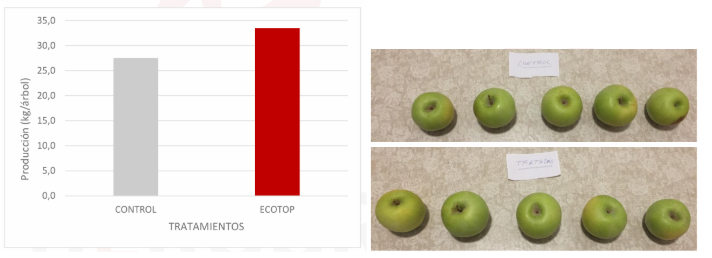
A 21 per cent increase in apple yield was observed where ECOTOP was applied before flowering, during flowering and after harvest.


